
Moving Inventory List: What Movers Need Before They Can Quote You
What a moving inventory is, why movers require one for accurate pricing, and how to build yours in minutes — including cubic feet, weight, and truck size.
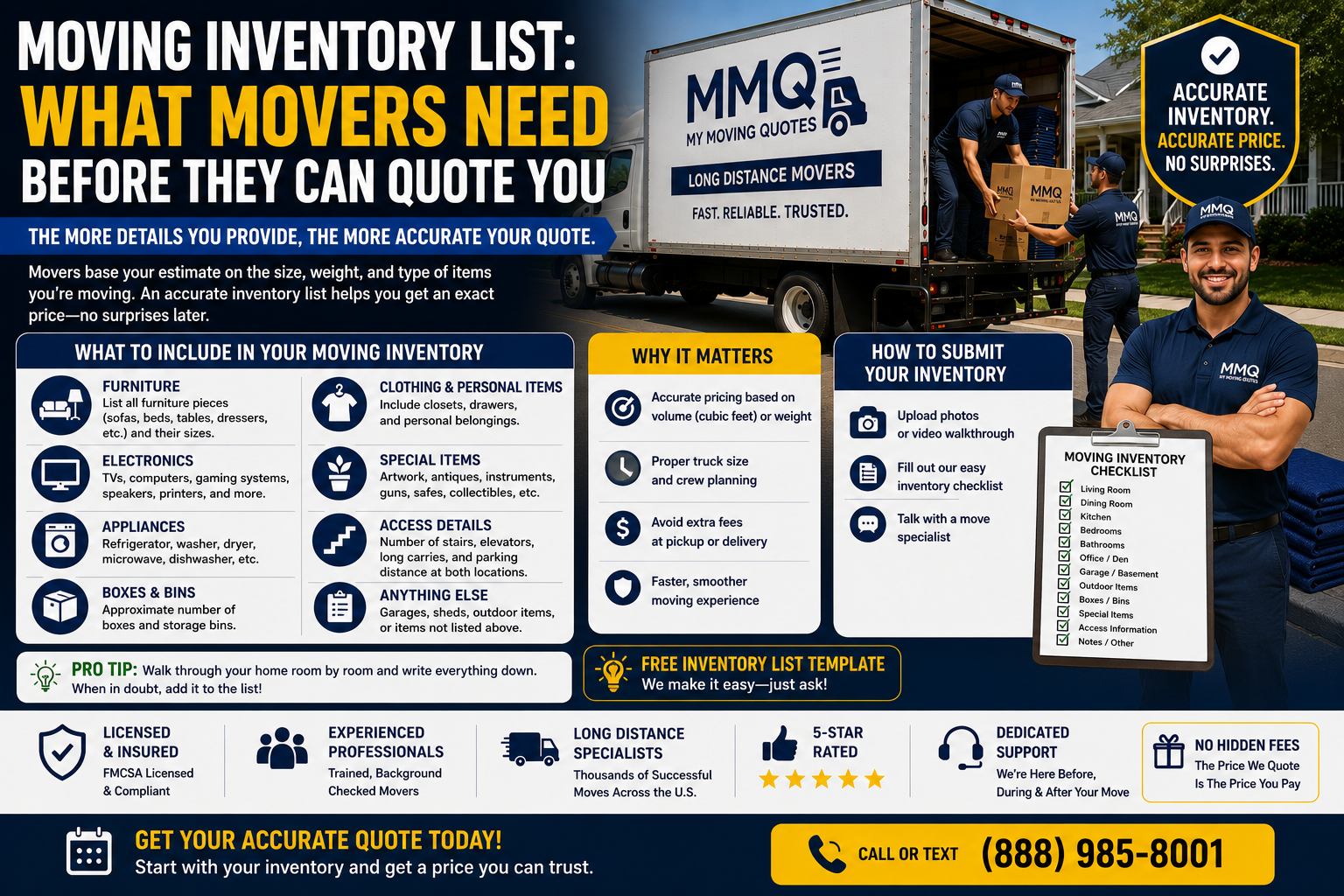
If you have ever gotten a moving quote that ballooned on moving day, there is a good chance the mover never had an accurate inventory of what you were shipping. This is the single most misunderstood part of long distance moving — and the easiest one to fix.
What Is a Moving Inventory?
A moving inventory is an itemized list of everything you are shipping: every sofa, bed, dresser, appliance, and box. Long distance moves are priced by weight or cubic feet, so the inventory is literally what the mover is pricing. No inventory means no accurate price.
Why Movers Need It Before Quoting
“Three bedrooms” tells a mover almost nothing. One 3-bedroom home might hold 1,400 cubic feet; another might hold 2,400. That is a difference of thousands of dollars on a cross-country move.
When a mover quotes you without an inventory, one of two things happens:
- They quote high to protect themselves, and you overpay.
- They quote low to win the job, then raise the price on moving day once the truck is weighed. This is the classic bait-and-switch, and it is legal if your estimate was non-binding.
An accurate inventory kills both problems.
What to Include on Your Inventory
Go room by room and count every item. At minimum, capture:
- Living room: sofas, loveseats, armchairs, recliners, coffee and end tables, TV and stand, bookshelves, rugs, lamps
- Bedrooms: bed sets (by size), dressers, nightstands, wardrobes, mirrors
- Kitchen: refrigerator, stove, dishwasher, microwave, table and chairs, bar stools
- Dining room: table, chairs, china cabinet, buffet
- Office: desk, chair, file cabinets, shelving, electronics
- Garage and outdoor: tools, mower, bikes, grill, patio furniture, ladders
- Appliances: washer, dryer, freezer
- Specialty items: piano, pool table, safe, treadmill, hot tub, motorcycle
- Boxes: counted by size — small, medium, large, extra-large, wardrobe
Do not skip boxes. On a full household move, boxes routinely account for 30–40% of total volume.
Cubic Feet, Weight, and Truck Size
Movers convert your inventory into cubic feet, then estimate weight at roughly 7 lbs per cubic foot. As a rough guide:
| Home Size | Typical Cubic Feet | Estimated Weight |
|---|---|---|
| Studio / 1 bedroom | 300 – 500 | 2,000 – 3,500 lbs |
| 2 bedrooms | 600 – 1,000 | 4,000 – 7,000 lbs |
| 3 bedrooms | 1,200 – 1,800 | 8,000 – 12,000 lbs |
| 4+ bedrooms | 1,800 – 2,600+ | 12,000 – 18,000+ lbs |
Build Your Inventory in Minutes
You do not need a spreadsheet. Our quote tool has a built-in inventory builder: check off your items room by room and it calculates your total cubic feet, estimated weight, and the truck size you need — in real time.
Movers then quote against your actual list, which means fewer surprises and a far more accurate price.
Want the Price Locked?
An online inventory gets you an accurate quote. If you want a price that cannot change, request an on-site walk-through. A licensed mover comes to your home, verifies the inventory in person, and issues a guaranteed binding contract.
Get Your Free Moving Quotes
Compare up to 5 quotes from FMCSA-licensed movers. Save an average of $1,200.